
Teaching activities
MSE 330: Thermodynamics of Materials
Introduction to the fundamentals of thermodynamics as applied to the study of condensed matter systems. The three laws of thermodynamics will be introduced as a basis for understanding heat, entropy, irreversible processes, equilibrium, chemical reactions, solid solutions, phase diagrams, and electrochemical systems. After completing the course, students will be familiar with both the theory and practical application of thermodynamics to problems in materials science.

MSE 535: Kinetics and Transport in Materials Engineering
Introduction to irreversible thermodynamics, Onsager’s principle, and the driving forces for diffusion; phenomenological theories for diffusive transport of mass and heat in crystalline solids; the motion of crystal-vapor, crystal-liquid, and crystal-crystal interfaces; and the kinetics of phase transformations in condensed systems, including nucleation, growth, coarsening, and spinodal decomposition.
MSE 550: Fundamentals of Materials Science and Engineering
This is an advanced level survey of the fundamental principles underlying the structures, properties, processing, and uses of engineering materials. It is intended for graduate students with no prior experience in materials science. Course content is organized in three thematic areas: materials structure, materials thermodynamics and kinetics, and mechanical properties. The goal of the course is to bring the students up to the level where they can take further advanced courses in these three areas.
MSE 593: Solidification Science: From Nanomaterials to Superstructures
Solidification is the process by which a liquid transforms into a solid. Understanding the fundamentals of solidification is essential for the design and development of a wide range of materials via casting, welding, additive manufacturing, and more. This course will provide students with a comprehensive overview of the principles and techniques involved in the solidification of both nanomaterials and larger-scale structures. The course will cover the growth of dendrites, eutectics, peritectics, and the factors that influence the final structure of the solid material under near-equilibrium and rapid solidification conditions. The course will also explore the latest advances in solidification science, including the use of in situ experiments and corresponding computational models.
Outreach activities

FEMMES (Females Excelling More in Math and Science) Capstone
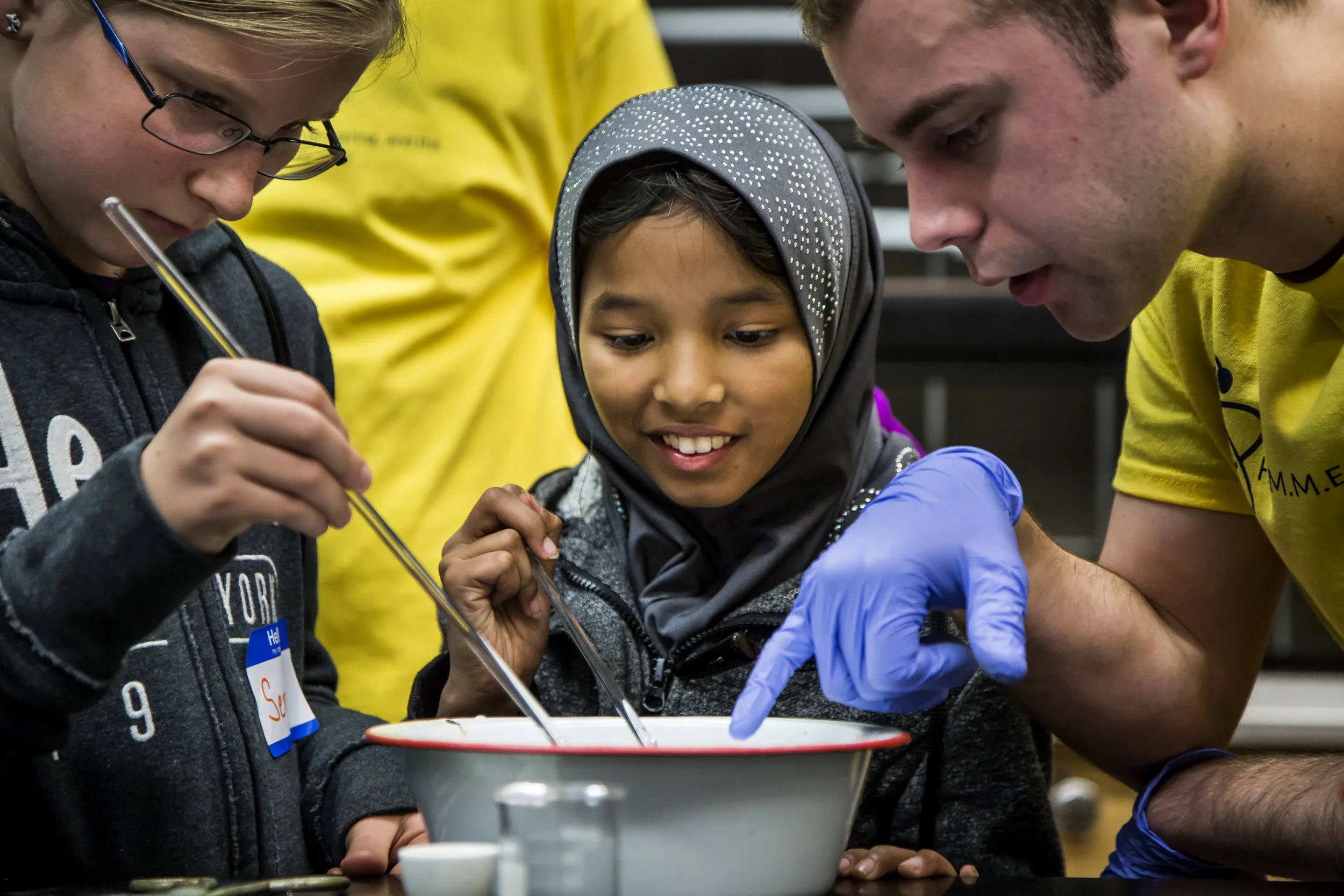
Visit our hands-on activity, entitled "The Magic and Mystery of Crystal Growth," at the bi-annual FEMMES science capstone, serving underrepresented female elementary and middle school students from the greater southeast Michigan community. Activities in our workshop have a specific emphasis on conveying the importance and application of crystal growth to modern technology (see left). As an example, the students are tasked with growing bismuth (Bi) and gallium (Ga) crystals as large as possible given limited supplies in the laboratory, and explaining their findings.
Xplore Engineering
Xplore Engineering is an outreach event designed for alumni and the children in their life entering the 4th through 7th grade. Through a series of experiential workshops, participants gain hands-on experience in a variety of engineering disciplines. Through the materials science department, Insung and Nancy helped run the workshop on "How do Crystals Grow? From Organic to Metallic Crystals," where kids investigated the rapid growth of different seeded crystals in far-from-equilibrium conditions.
DAPCEP (Detroit Area Pre-College Engineering Program)
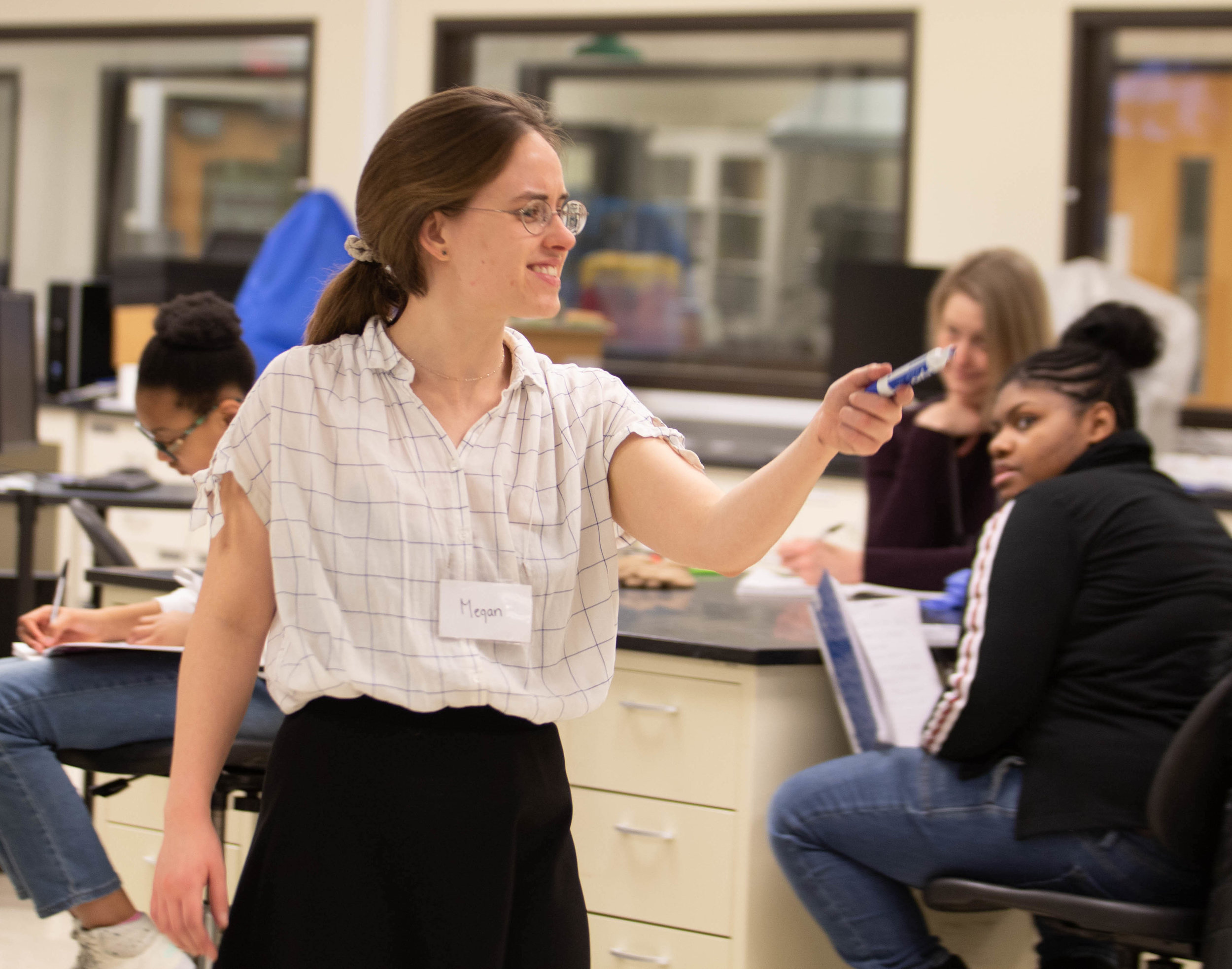
Cooking is one of the oldest human activities, second only to survival. It may also be one of the oldest and most widespread examples of materials science and engineering. Through this experiential learning activity, students from Detroit area middle schools engage all of their senses to learn about various materials principles — including heat treatments and phase changes — that underlie both everyday cooking as well as haute cuisine. Led by our very own Megan Wiltse (right), our activity is organized as follows: First, we introduce the scientific concepts to be explored in the activity. Then, the students are given rough recipes for them to follow; they will be allowed to adjust proportions, ingredients, cooking times, etc., in order to best replicate the appearance and flavor of the dish. Lastly, in the style of the hit TV show Top Chef, a panel of judges will examine the students’ creations and ask them to justify their cooking methods by using their working knowledge of materials science and engineering. This activity was funded by the National Science Foundation CAREER Program under Award No. 1847855.
WESO (Washtenaw Elementary Science Olympiad)
The Washtenaw Elementary Science Olympiad (WESO) inspires young minds in grades 2–5 to explore STEM, build teamwork, and showcase their scientific talents. Profs. Shahani and Thornton (pictured together, at right) have teamed up to organize “Photon Phun,” an event at WESO 2025 and 2026 that introduces elementary school students to photons and electromagnetic waves (including X-rays) in a “phun” way. Their event consists of knowledge test and a hands-on activity based on the concept of reflection using mirrors.

Jiwoong Kang (right) helps students (left and center) understand the physics behind spherification. Taken during DAPCEP; spring 2019.