
Research thrust
Broadly, the Shahani group employs synchrotron- and laboratory-based methods, including X-ray tomography and diffraction, to peer into the solidification and processing pathways of metallic alloys in real-time, from the nanoscale to the microscale. Such studies would not be possible without the great strides in data sampling and reconstruction, computer hardware and storage, and algorithms for excavating the Big Data in a massively parallel environment. It is anticipated that our in situ, multimodal, and multiscale approach will provide a fresh lens for solving age-old problems in the field of physical metallurgy. Below, we outline our particular interests.

One of our playgrounds: sector 2-BM at Argonne National Laboratory's Advanced Photon Source.

Icosahedral QC in liquid, imaged via X-ray microtomography. Superimposed is a Penrose tiling.
Formation of complex intermetallics
Most intermetallic compounds adopt non-trivial or “complex” geometries. In fact, only around 6% of phases are comprised of the simplest sphere packings that we associate with metals. Our current understanding of phase transformations (like solidification) does not encompass the remaining 94% of intermetallics that possess complex and aperiodic structure types. As a prototypical example, quasicrystals (QCs) are sometimes called Nature’s “forbidden” crystals because their structure is ordered but aperiodic. This means that quasicrystalline patterns (e.g., Penrose tiling shown at left) fill all available space, but in such a way that the pattern of its atomic arrangement never repeats. The growth mechanism of QCs — and more generally, complex intermetallics — is one of the still-open questions since Shechtman’s discovery over 40 years ago. Multiple growth models have been proposed, nearly all of which lack experimental verification.
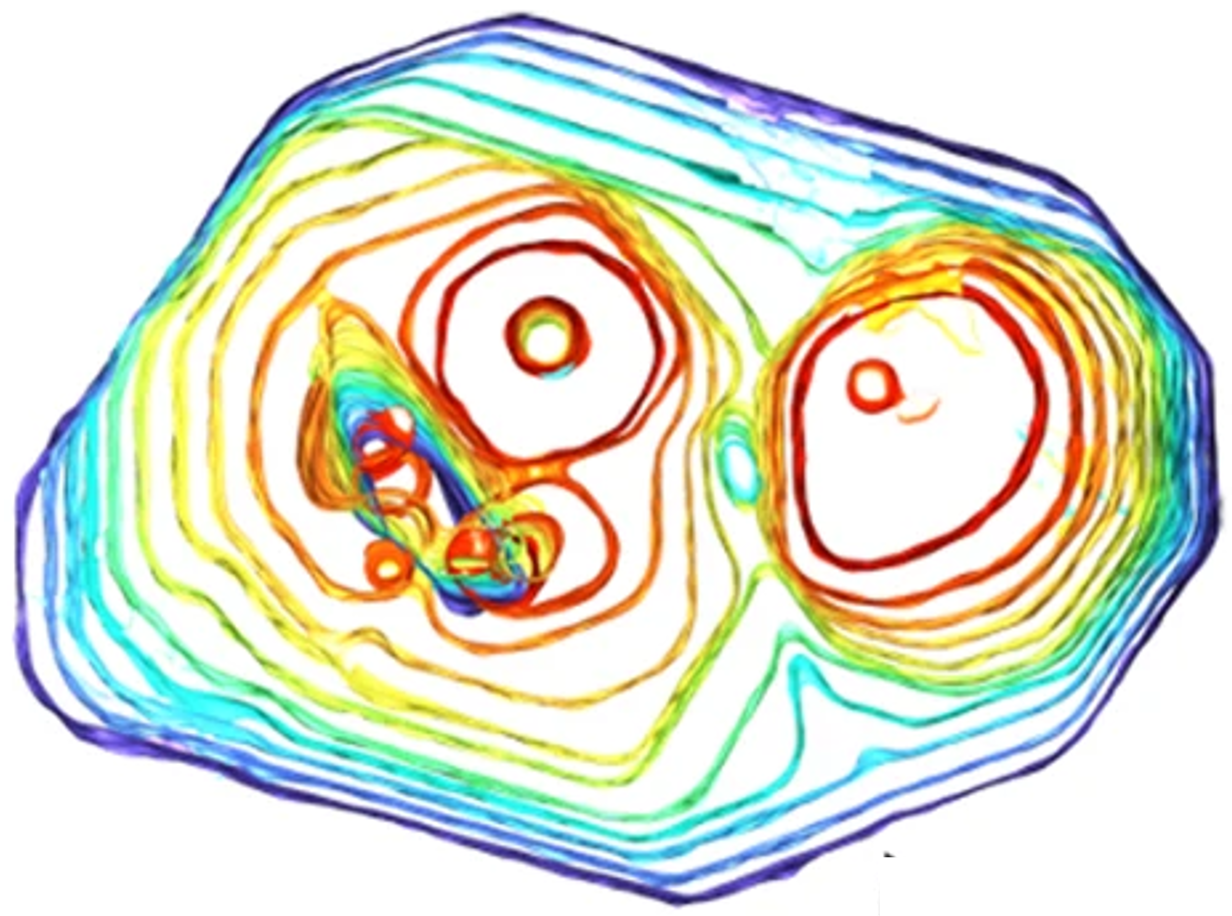
Hard impingement of decagonal QCs over time during growth (colored isochrones).
Using synchrotron-based 4D (i.e., 3D space and time-resolved) imaging, we have had the unique opportunity to watch the growth of quasicrystals from a liquid. In particular, we have captured the equilibrium and growth shapes of an icosahedral quasicrystal; the growth and dissolution kinetics of a decagonal quasicrystal; as well as the growth of a periodic (approximant) phase that shares structural motifs with a decagonal quasicrystal phase. We have also captured through dynamic transmission electron microscopy the highly unusual, dendritic growth of icosahedral quasicrystals born from an approximant matrix. Even more recently, we have discovered the “self-healing” behavior of quasicrystals upon impingement with other quasicrystals (see image at right, depicting solid-liquid interfacial isochrones) and external obstacles in the melt. These discoveries enable us to better predict and control the synthesis of intermetallic phases near- and far-from-equilibrium. This research has been funded by the U.S. Department of Energy (DOE), Office of Science, Office of Basic Energy Sciences, under Award Nos. DE-SC0019118 and DE-SC0023147.
This growing knowledge base is especially important in addressing a global grand challenge: the development of sustainable aluminum-based alloys. To reduce greenhouse gas emissions and promote a circular economy, we must replace the need for primary aluminum with post‑consumer scrap. However, scrap contains large quantities of undesirable compounds, particularly Fe-and Si-based intermetallics, which are highly detrimental to mechanical properties due to their complex (and often acicular) morphologies. We aim to tackle this challenge by combining CALPHAD (CALculation of PHAse Diagrams) simulations and real-time imaging experiments to investigate the effect of alloying additions on the solidification and homogenization pathways. In collaboration with several industry partners across the aluminum supply chain, my group will analyze the microstructures of commercial scrap aluminum, ensuring a transition from controlled laboratory experiments to real‑world alloys. Research on cast Al alloys has been funded by the Ford University Research Program while that on wrought Al alloys has been funded by Hydro Holding North America.
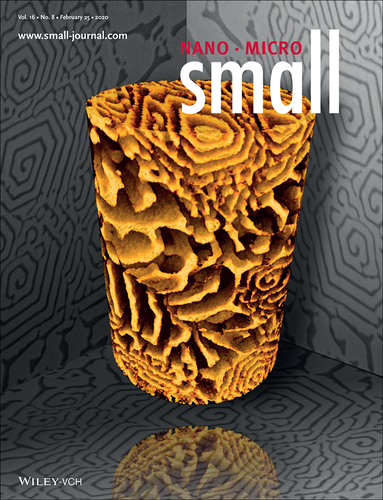
Faceted spiral structure of a two-phase eutectic imaged via X-ray nanotomography.
Formation of natural composites
Composite materials are of great interest to the aerospace and automotive sectors and the defense agencies due to their enhanced mechanical and functional properties over those of monolithic alloys. In particular, eutectics are a paradigm of natural composite material consisting of two (or more) entangled solid phases. The simultaneous crystallization of eutectic solids creates highly ordered patterns of remarkable complexity, including rod, lamellar, spiral, and labyrinthine (to name a few). Yet the selection of microstructure in eutectic solidification remains elusive to-date. For example, the morphology of the eutectic phases depends on the driving force for solidification, the anisotropy in interfacial energy and interfacial mobility (solid-liquid and solid-solid), as well as the chemical environment of the parent liquid phase.
Recent advances in the temporal and spatial resolutions of synchrotron X-ray micro- and nano-tomography allow us to probe in 3D and 4D the solidification of eutectics for the first time. With this technique, we have discovered the origin of spiral eutectics (see image at top-left); the role of dopants on modifying the eutectic microstructure; the formation of long-range instabilities, such as eutectic cells and macrofacets; the emergence of banded and lamellar peritectic patterns that mimic eutectic structures; the coarsening of eutectic microstructure upon annealing in the solid-state; the growth modes of eutectics with faceted phases; and their transient solid‑liquid interfacial shapes, including the geometry of the solid‑solid-liquid triple junctions. The latter results suggest an underlying universality in the solidification dynamics of metallic, ceramic, semiconductor, and organic eutectics, which we hope to elucidate in the near future. Research on spiral eutectics, peritectics, and irregular eutectics has been funded by the Air Force Office of Scientific Research under Award Nos. FA9550-18-1-0044, FA9550-21-1-0260, and FA9550-25-1-0076, respectively. Research on chemical modification of eutectics has been funded by the National Science Foundation CAREER Program under Award No. 1847855.
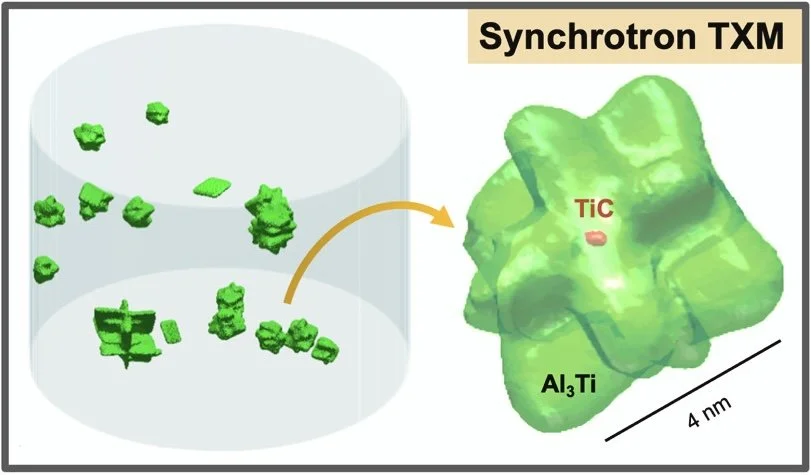
Hierarchical structure of TiC/Al metal matrix nano-composite, consisting of TiC, Al-Ti intermetallics, and Al matrix.
Another class of natural composites is in situ metal matrix nano-composites, where the reinforcing phase is synthesized directly in the molten metal matrix. The morphology, size, and distribution of the reinforcing phase (e.g., TiC, see image at right) depends on the kinetics of the in situ reaction that takes place within the molten matrix. Using high‑resolution X-ray imaging, we have captured the reaction pathways and microstructural signatures associated with both self‑propagating high-temperature synthesis and reactive flux-assisted processing. Currently, we seek to understand the redistribution of the particles during solidification, with the goal of creating uniform and gradient polyphase microstructures. This line of research has been funded by the National Science Foundation GOALI Program under Award Nos. 1762657, 2124532, and 2432130.
Formation of polycrystalline microstructures
Technological materials are rarely utilized in their as-solidified state but instead after various thermo‑mechanical treatments. During thermal processing, normal grain growth occurs, wherein some solid grains enlarge while others shrink and disappear. A second possibility, termed abnormal grain growth, is that a very few grains grow at a much faster rate than the others and eventually consume the sample volume. Abnormal grain growth has been observed in a vast array of metallic and ceramic systems, yet its origins have remained an enigma for at least the past seventy years. The fundamental questions in AGG are which grains are selected and why (the “selection problem”), and how the grains grow into the microstructure (the “persistence problem”). By addressing these questions, we can engineer microstructures to be either single-crystalline or fine-grained, depending on the technological demands.
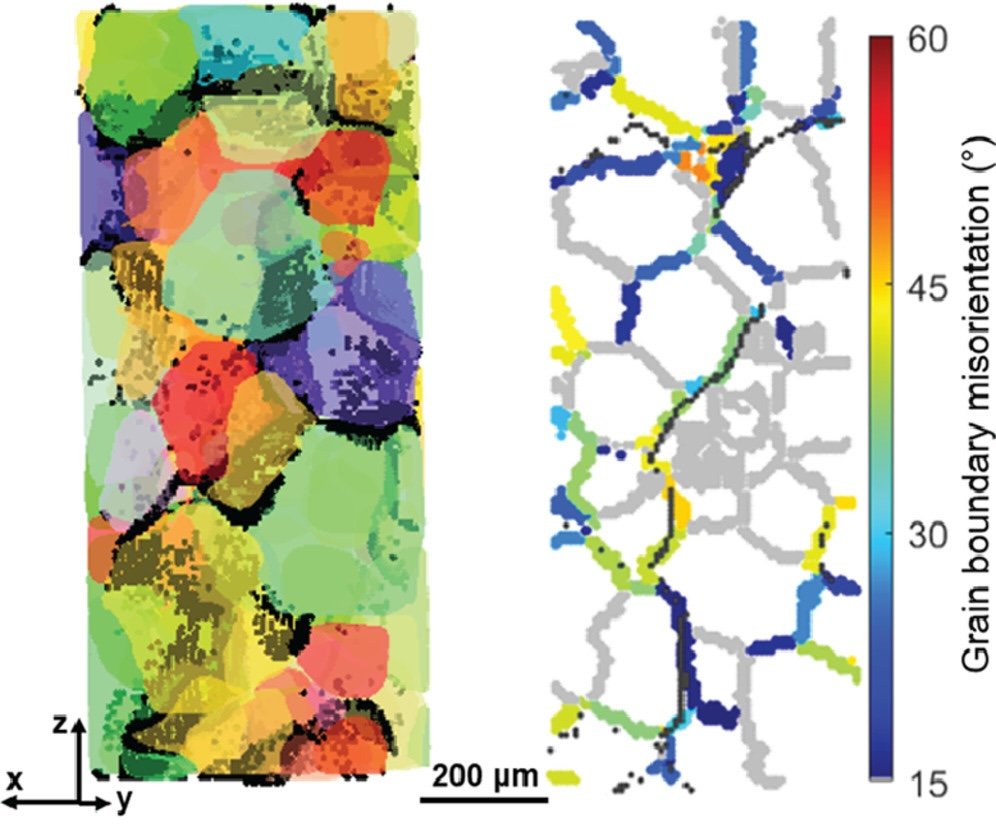
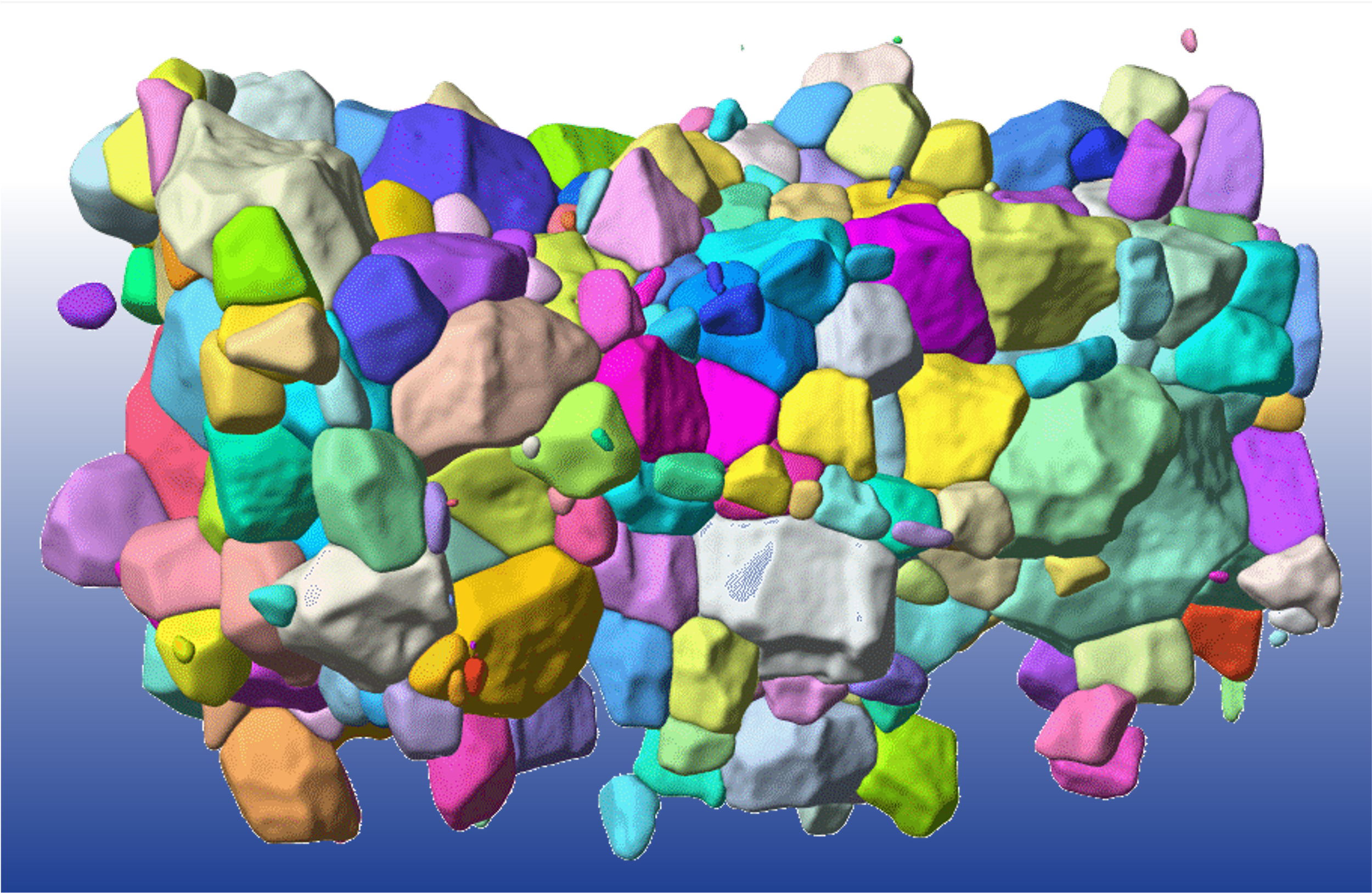
3D percolation pathway of liquid metal (black) in Al (colored grains). Imaged via laboratory X-ray diffraction contrast tomography.
Because grain growth is relatively slow, conducting synchrotron-based imaging studies is not always practical due to limitations on available beam-time. For this reason, we have pioneered a new, laboratory‑based imaging platform: our approach uses an X-ray microscope to yield 3D chemical and crystallographic information via absorption- and diffraction-based tomography, respectively. With this multimodal approach, we have followed the dynamics of AGG in the presence of second-phase, intermetallic particles; the impacts of free surfaces on microstructure evolution; and the dynamics of percolative phenomena (e.g., liquid metal embrittlement, see image at left) that occur principally along the grain boundaries and triple junction lines. The connection between percolation and grain growth remains a fertile and untapped area of exploration — for instance, it could be envisaged that a percolating cluster of highly-mobile grain boundaries give the abnormal grain its persistent growth advantage. This research has been funded by the Army Research Office under Award Nos. W911NF-18-1-0162 and W911NF-22-2-0057.
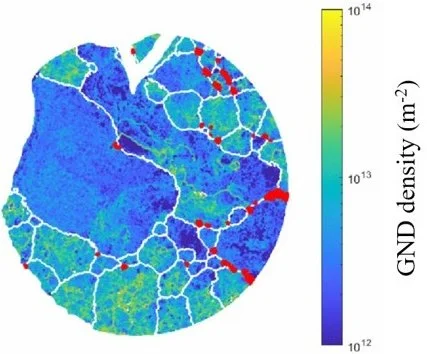
Stored-strain-energy map in shape memory alloy. Data obtained from HEDM.
It is worth mentioning that abnormal grain growth may also occur in response to phase transformations, e.g., during or after the dissolution of the second-phase particles upon heating (i.e., non-isothermal annealing). In this case, we must contend with a complex interplay between many physical effects (e.g., inhomogeneous stored-strain energy [see image at right] and particle pinning pressures), which may give rise to exotic phenomena such as grain translations. We are actively exploring the origins of (abnormal) grain growth under such dynamic annealing conditions through synchrotron-based high energy x-ray diffraction microscopy (HEDM). This research is funded by the National Science Foundation under Award Nos. 2003719 and 2104786.
Finally, as these new 3D diffraction-based techniques become increasingly accessible to researchers, demands are placed on processing the datasets that are inherently multimodal and high-dimensional. To this end, we have developed new data processing pipelines that can parse the full spectrum of experimental data obtained from such techniques. Even so, locating the relevant information in a vast “sea” of data is a challenge. This task is well-suited to the emerging methods of data science and machine learning. For example, we have implemented a Graph Neural Network (GNN) framework that models the dynamic interactions between grains and their neighbors in order to track the fate of grains in time-resolved datasets.
Quisque iaculis facilisis lacinia. Mauris euismod pellentesque tellus sit amet mollis.