Peering into the formation of "forbidden crystals"

In a new paper published in Physical Review Letters, we track in situ the solid‑state formation of metastable and dendritic quasicrystals. On the basis of our time‑resolved transmission electron microscopy experiments and supporting molecular dynamics simulations, we provide an atomic picture of how periodic crystalline (approximant) structures evolve into quasicrystalline structures in terms of their structural similarity and how the interface between the quasicrystal and approximant supports the formation of dendrites (tree-like structures). Ultimately, we show that a 13-atom icosahedral motif is dominant upon rapid annealing, and if a sufficient population of these motifs exist, they could guide phase selection. Such motifs are the essential building blocks for quasicrystal growth from a solid or a liquid precursor. Congratulations Insung and Parsa!

Read more at University of Michigan  →

Spirals take the spotlight

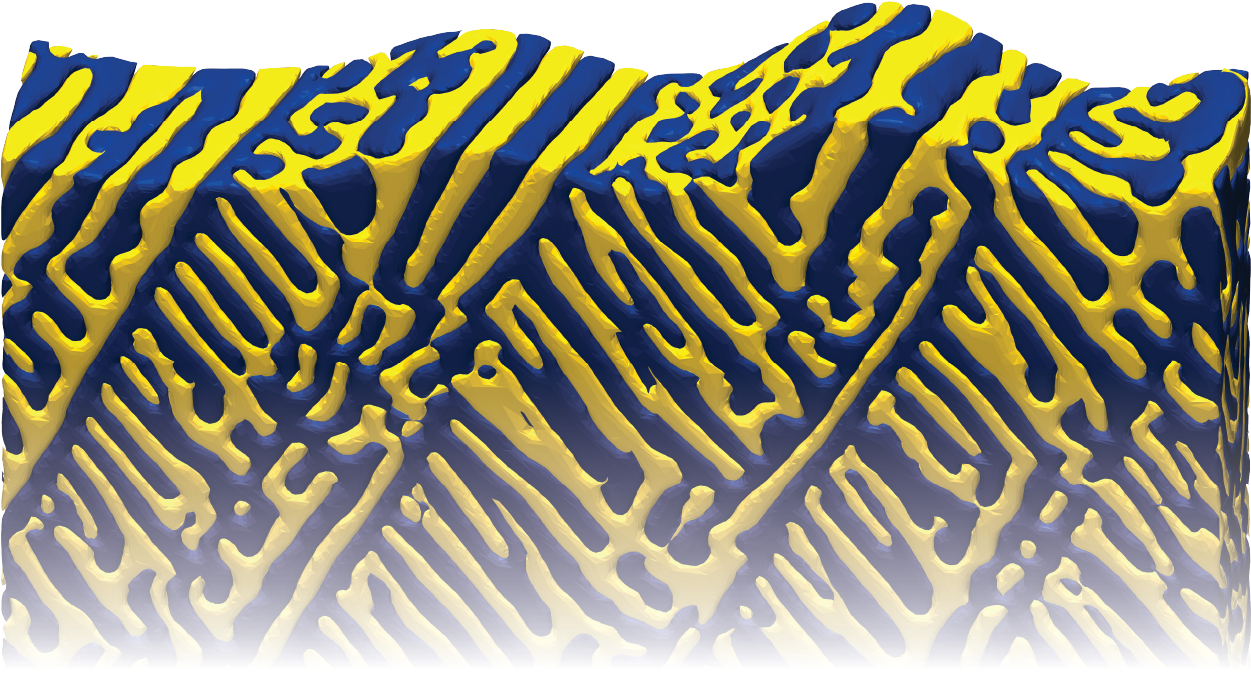
In an article published very recently in the journal Small, we investigate the origins of certain eutectics that grow into spiral geometry. The spiral formation follows a two‐step process, wherein the first step is mediated by the low solid–liquid interfacial energy of a precursor phase, and the second step by crystallographic defects on the precursor. The cover at right features a computed X‐ray nano‐tomography image of spiral eutectics in Mg‐Zn alloy showing multiple spiral eutectic colonies with the eutectic MgZn2 and Zn phases shown in dark and light false colors (image courtesy of H. Bale). Way to go Saman, Yeqing, and coworkers!

'“As molten metal alloys cool, solid structures begin to form internally as small atomic clusters crystallize. By fine-tuning the cooling conditions, researchers can steer these crystallization mechanisms to produce a range of different structures in solid materials. Particularly intriguing structures can arise through non-equilibrium cooling – including “spiral eutectics”, which arise in mixtures of two or more solid metal phases. These materials can spontaneously self-arrange themselves into spirals resembling a DNA helix …”

Read more at Physics World  →

A productive year for the team

We have been working very hard this year, the result of which is a number of new publications available online! Here are some highlights: Ning (left) presented his published research at the Microscopy and Microanalysis annual meeting. Saman (right), too, showcased his work at the UM Chemical Engineering Graduate Symposium, for which he won an award for the “Best Oral Presentation.” Several other students (center) have conducted synchrotron imaging experiments at Argonne, Brookhaven, and Rutherford Appleton Laboratory. We can’t wait to present results from some of these new projects at the upcoming MRS symposium MT06, to be chaired by Prof. Shahani! See you soon in Boston.